

The Talos Principle (Mobile): a big philosophical puzzle on your phone
The Talos Principle is one of those rare puzzle games that respects the player’s intelligence. It isn’t just about lasers and switches; it’s about questions that stay with you after you put the phone down. Originally released on PC in 2014, it later arrived on Android and iOS, bringing its first-person, open-ended puzzle design to mobile without losing its identity.
What you’re actually playing on mobile in 2026
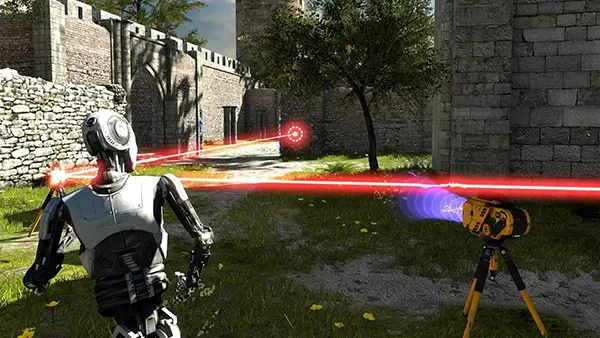
On mobile, you’re getting the core game: a first-person puzzle adventure built around self-contained areas where you solve challenges using tools such as jammers, connectors, fans, and recording devices. The design is deliberately spacious and non-linear, which means you often have more than one way to approach a problem. The game actively encourages experimentation rather than forcing a single “correct” route.
In terms of scale, this is not a shortened mobile experience. Depending on how you play, you can easily spend well over twenty hours completing the main puzzle areas, especially if you take time to explore, read terminals, and solve optional challenges. The pacing also suits mobile habits because you can finish one or two puzzles in a short session and come back later without losing the thread.
It is also a premium release rather than a free-to-play conversion. That matters because the structure is built around a complete experience: no energy systems, no artificial timers, and no constant prompts to buy boosts. You pay once and get a coherent single-player game that respects your time and attention.
Story, themes, and why the writing still lands
The setup is simple but effective: you wake in a world that blends ancient ruins with advanced technology, and a guiding voice sets you a series of tests. Over time you read messages, interact with terminals, and piece together why this place exists. The narrative doesn’t try to preach. Instead, it presents competing ideas and leaves room for you to decide what you believe.
What works especially well on mobile is the way the story is delivered in fragments. You can solve a puzzle, read a short terminal exchange, and then stop. The philosophical layer is built gradually, which makes it easier to absorb when you’re playing in short bursts. Even if you’re not actively looking for deeper meaning, the tone stays consistent and the writing feels deliberate rather than decorative.
If you enjoy games that are worth discussing afterwards, The Talos Principle gives you a lot to unpack. It explores identity, purpose, and the limits of artificial intelligence without relying on shock twists. The world-building remains clear enough to follow even if you don’t read everything, but the full experience is richer when you do.
Controls, usability, and the “phone factor”
The biggest question for many players is whether a first-person puzzle game feels natural on touch controls. In practice, it works better than most people expect because the challenges rely on observation and planning, not fast reflexes. You spend more time positioning tools, lining up beams, and thinking through timing than performing rapid combat-like movements.
Mobile play does change how you approach certain moments. Fine camera adjustments can feel slower than on a mouse or controller, and small screens can make visual scanning slightly more demanding. Many players find it most comfortable on larger displays, especially when reading terminal text or checking distant puzzle elements.
The game’s structure supports mobile sessions because it is built around puzzle “chunks.” You can complete one area, save, and stop without the feeling that you’ve abandoned a long mission. This makes it a solid choice for commuting, breaks, or evenings when you want something mentally engaging but not frantic.
Performance, storage, and practical settings advice
In 2026, modern phones handle The Talos Principle reliably, but it is still a sizeable 3D game, so storage space matters. Before downloading, it’s sensible to check your available memory and keep a little extra free space for system caching. The game’s environments are large, and that scale is part of its charm, but it also means the app is not lightweight.
Battery use depends on your device and settings. If your phone gets warm during longer sessions, lower screen brightness and reduce visual settings where possible. Playing while charging is often the smoothest option for extended puzzle runs, as sustained performance can drop if your device starts throttling due to heat.
If you notice stuttering, the simplest fix is to close background apps and restart the game. First-person movement combined with detailed environments can be memory-hungry, especially on older devices. A clean start often improves stability more than constantly switching settings while you play.
Why it’s still worth your time in 2026
By 2026, mobile puzzle games are everywhere, but many are built around short tricks, hint systems tied to adverts, or repetitive mechanics. The Talos Principle still stands out because it feels closer to a carefully written novel combined with a robust puzzle box. It gives you space to think and rewards curiosity, which is exactly why it remains relevant.
Another reason it holds up is the way the puzzles scale. Early challenges teach you the rules clearly, and later ones combine systems in ways that feel earned rather than random. You are rarely blocked because the game is unfair. Instead, you’re blocked because you haven’t noticed the right angle yet, and when it clicks, it feels genuinely satisfying.
It also remains a strong option for players who want a premium mobile game that feels complete. The experience is built to be finished, not endlessly monetised. If you want a thoughtful single-player title you can work through over time, this is still one of the most solid choices available.
Who should play, who might bounce off, and how to start well
You’ll probably enjoy it if you like first-person logic puzzles, exploration, and stories that raise questions rather than giving easy answers. It is particularly good for players who like learning systems and then applying them creatively. If you’ve enjoyed puzzle design that rewards patience and attention, you’ll feel at home.
You might not love it if you want constant action or very fast progression. The narrative layer is delivered through terminal text and environmental clues, and while you can ignore much of it, you lose a major part of what makes the game special. It’s a title that expects you to slow down and think.
To start well, treat the first hour as training. Learn what each tool does, and don’t rush to brute-force solutions. If you hit a wall, leave that puzzle and try another one, then return later. The game is designed for that non-linear approach, and on mobile it’s often the quickest way to make progress.