
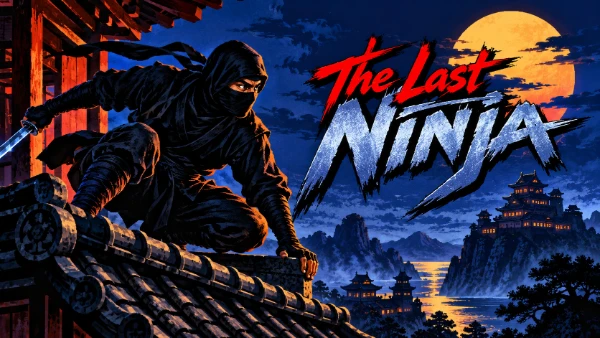
The Last Ninja Is Back: Why Commodore 64 and Amiga Games Are Returning to Modern Consoles
For players who grew up with a Commodore 64 or Amiga beside the family television, The Last Ninja needs little introduction. System 3’s isometric action-adventure series was one of the defining names of European home-computer gaming, combining exploration, martial-arts combat, puzzle solving and remarkably atmospheric presentation. Nearly four decades after the first game appeared, that history is accessible again without hunting down ageing hardware or relying on unofficial copies. The Last Ninja Collection + Bonus Games reached Windows PC in December 2025 and Nintendo Switch in March 2026, bringing several versions of the series together with International Karate, IK+ and Bangkok Knights. Its arrival is part of a wider change in retro gaming. Commodore 64 and Amiga titles are increasingly being treated not simply as nostalgic curiosities but as games worth preserving, selling and playing on current hardware.
The Last Ninja’s Return Is More Than a Nostalgia Release
The original The Last Ninja appeared on the Commodore 64 in 1987 and quickly became one of System 3’s best-known releases. Its appeal came from an unusual mixture of ideas. Players controlled Armakuni across isometric environments where progress depended on more than defeating opponents. Weapons had to be found, objects used in the correct locations and environmental obstacles understood before the journey could continue. At a time when many home-computer action games were built around short arcade-style stages, The Last Ninja attempted to create the impression of travelling through a connected place. Its distinctive viewpoint, large character sprites and Ben Daglish’s memorable Commodore 64 music helped give the game an identity that remains recognisable decades later.
The series expanded rapidly. Last Ninja 2 arrived in 1988, moving the action from the first game’s feudal setting to modern-day New York. It was followed by Ninja Remix and Last Ninja 3, with several entries appearing in versions for other computers, including the Amiga and ZX Spectrum. Those conversions matter because home-computer gaming during the 1980s and early 1990s was rarely built around one identical edition. A Commodore 64 release could differ noticeably from an Amiga version in graphics, music, loading behaviour and even the way a game felt to control. Keeping several of those versions available therefore preserves more than the basic game design; it preserves part of the character of the machines on which people originally played them.
System 3’s modern collection emerged from a Kickstarter campaign launched in 2024. The campaign set an initial target of £10,000 and ultimately attracted 1,805 backers who pledged £188,623. That level of support is significant for a group of games whose roots stretch back to the 1980s. The finished collection subsequently reached Windows through Steam on 18 December 2025, followed by Nintendo Switch on 5 March 2026. PlayStation 4, PlayStation 5 and Xbox Series X|S editions were also announced during the project. The important point is not simply that an old name has been reused. System 3 has returned to the original games themselves, presenting their historical versions rather than replacing them with completely redesigned modern interpretations.
What The Last Ninja Collection Actually Includes
The collection brings together seven games: The Last Ninja, Last Ninja 2, Last Ninja 3, Ninja Remix, International Karate, IK+ and Bangkok Knights. The first four provide the core Ninja material, while the remaining three represent other important System 3 releases from the same period. International Karate and IK+ are especially appropriate companions because martial-arts games were a major part of the company’s reputation on the Commodore 64. Bangkok Knights extends that connection with another fighting game from 1987. Rather than focusing on a single famous title, the package therefore gives players a broader sample of the style of action games System 3 was producing during the C64 and Amiga years.
Another useful feature of the collection is the inclusion of versions from different home computers where they existed. Nintendo describes the release as containing seven titles across 15 formats, with Commodore 64, Amiga and ZX Spectrum editions represented. The Last Ninja itself is presented in its C64 form, while games such as Last Ninja 2, Ninja Remix and IK+ can be experienced through more than one historical edition. For someone approaching these games for the first time, the differences may initially appear minor. For players familiar with the original hardware, however, alternative graphics, sound and presentation can be an important part of how a particular game is remembered.
This also makes the release more useful as a record of home-computer history. Modern remakes can be entertaining, but a remake inevitably reflects the design habits of the period in which it is created. Preserved versions show how developers actually solved problems with the memory, storage, displays and controllers available at the time. The Commodore 64’s SID audio chip encouraged a distinctive musical style, while the more powerful Amiga allowed richer graphics and sound in many conversions. Seeing those editions beside one another makes the technological progression easier to understand without turning the experience into a museum exercise. The games remain playable works rather than screenshots or video clips documenting what they once looked like.
Why Commodore 64 and Amiga Games Still Work on Modern Hardware
The continuing appeal of C64 and Amiga games is partly explained by their directness. Many were designed around a small number of controls because the original machines were commonly used with a one-button joystick. Developers could not depend on lengthy tutorials, large amounts of recorded dialogue or elaborate interface systems. A game had to communicate much of its purpose through movement, level design, visual cues and a short printed manual. The results could be unforgiving, but the basic interaction was often easy to grasp. That makes many old computer games surprisingly suitable for modern controllers once the original inputs have been mapped sensibly.
The Last Ninja demonstrates both the strengths and the awkwardness of that design philosophy. Moving through an isometric landscape can initially feel unusual to somebody accustomed to modern analogue-stick controls, while combat is considerably more deliberate than in a contemporary action game. Yet those limitations also create the series’ rhythm. Players must judge positioning, watch an opponent’s movement and work out where the environment can be crossed safely. Progress is not driven by a stream of markers telling the player exactly where to go. The game expects observation and experimentation, qualities that can make it feel refreshingly different beside modern releases built around extensive guidance.
Shorter sessions also suit the way many people use current hardware. An older action or arcade game does not necessarily require dozens of hours before its main ideas become clear. International Karate or IK+ can provide meaningful play within minutes, while The Last Ninja offers compact areas that can be tackled individually. This does not mean older games are automatically more accessible: difficulty spikes, limited instructions and unfamiliar control conventions remain genuine barriers. What has changed is the context. Players can now approach a 1980s game as one choice within a much larger library, spend some time understanding its rules and return later rather than expecting it to behave like a new release.
Old Technical Limits Became Part of the Games’ Identity
Commodore 64 and Amiga developers worked within restrictions that would be almost unimaginable for a major commercial game today. Storage was tiny, memory was measured in kilobytes rather than gigabytes and every visual or audio element had to justify the space it occupied. These restrictions often encouraged recognisable artistic solutions. C64 artists became skilled at building detailed scenes from a restricted colour palette, while musicians used the SID chip’s three sound channels to create pieces that suggested far more complexity than the specifications might imply. The distinctive look and sound were therefore not filters added to imitate an earlier period; they were direct results of designing for those machines.
The Last Ninja is a particularly strong example. Its isometric scenes use carefully arranged architecture, vegetation and objects to make relatively small areas feel larger and more dramatic. Animation is limited by modern standards, yet the large ninja character gives the action a physical presence that many contemporary C64 games lacked. The music plays an equally important role. Instead of attempting realistic recorded sound, the composers worked with synthesised voices and repeating themes that could run within strict memory limits. Those choices became inseparable from the series. Replacing them with technically superior assets would produce a different experience rather than simply an improved version of the same one.
The Amiga represents another important stage of that history. When Commodore launched the Amiga 1000 in 1985 and later the hugely popular Amiga 500, the range offered advanced graphics and sound compared with many earlier home computers. Developers could use a broader colour range, sampled audio and more elaborate visual presentation. Games converted from the C64 therefore provide an interesting snapshot of changing expectations. An Amiga edition might look cleaner and sound richer while still following design rules established on older hardware. Modern collections that retain both editions allow players to see that transition directly instead of treating the entire period as one indistinguishable era of pixel art.
Why Publishers Are Bringing Classic Computer Games Back
One reason old computer games are returning is practical: playing them legally has become easier. For many years, somebody interested in an Amiga or C64 title often faced an awkward choice between buying ageing second-hand hardware and software or locating unofficial copies online. Rights ownership could be complicated, original disks and tapes deteriorated, and computers from the period required equipment that many households no longer kept. Official digital reissues remove much of that friction. When copyright holders can establish ownership, prepare working versions and distribute them through current stores, an old catalogue can become commercially useful again rather than remaining inaccessible in an archive.
The audience has also broadened. Retro gaming once centred heavily on collectors who wanted original machines, boxes and physical media. That community remains active, but it now exists alongside players interested primarily in the games themselves. A Nintendo Switch owner does not need to understand how a Commodore 64 disk drive worked to appreciate The Last Ninja, just as a younger player can enjoy an old arcade game without having visited an arcade in the 1980s. Services specialising in licensed retro releases have strengthened that trend. Antstream Arcade, for example, listed more than 1,300 officially licensed games in 2026 and included dedicated selections for systems such as the Commodore 64 and Amiga.
Preservation provides another reason to revisit these catalogues. Video games are unusually vulnerable historical objects because keeping the original data is not always enough. A cartridge, disk image or program file may survive while the hardware needed to run it becomes scarce. Rights disputes can prevent commercial redistribution, and games tied to obsolete services may disappear completely. Reissues cannot solve every preservation problem, but they can keep important works in circulation and remind rights holders that there is value in maintaining older catalogues. The Last Ninja Collection is especially relevant because System 3 has explicitly connected the project with preserving games from its early history rather than presenting the release as a newly created sequel.
What the Retro Revival Means for Players in 2026
For returning players, collections such as this one reduce the distance between memory and reality. Nostalgia has a habit of smoothing away awkward controls, long loading times and moments of frustration, so replaying an original version can sometimes be surprising. Certain games hold up remarkably well; others clearly show their age. Both outcomes have value. Being able to play the actual game makes it possible to judge its design rather than relying on screenshots, childhood memories or claims about its historical importance. The Last Ninja’s atmosphere remains distinctive, but its movement and combat also remind players how much action-game conventions have changed since 1987.
For younger players, these releases provide context for ideas that now seem ordinary. Isometric worlds, environmental puzzles, martial-arts combat, exploration and cinematic presentation did not begin with modern hardware. Developers were experimenting with ways of combining those elements while working under severe limitations decades earlier. The same applies to Amiga titles that used sampled sound, detailed sprite art and increasingly elaborate presentation before CD-based consoles made large amounts of storage commonplace. Playing those games can therefore make gaming history more concrete. It shows not only what old software looked like but how designers approached familiar problems with very different tools.
The Last Ninja’s return is therefore best understood as part of a continuing effort to keep early computer gaming playable. The Windows and Nintendo Switch releases give the series a place on hardware used today, while the wider growth of licensed retro catalogues is making C64 and Amiga software easier to access without reconstructing an entire vintage setup. These games will not appeal to everybody, and preserving them does not require pretending that every ageing design choice remains convenient. Their importance lies elsewhere: they document a period when developers were defining genres, inventing visual languages and learning how far home computers could be pushed. In 2026, that history is no longer confined to collectors’ shelves. It can still be played.